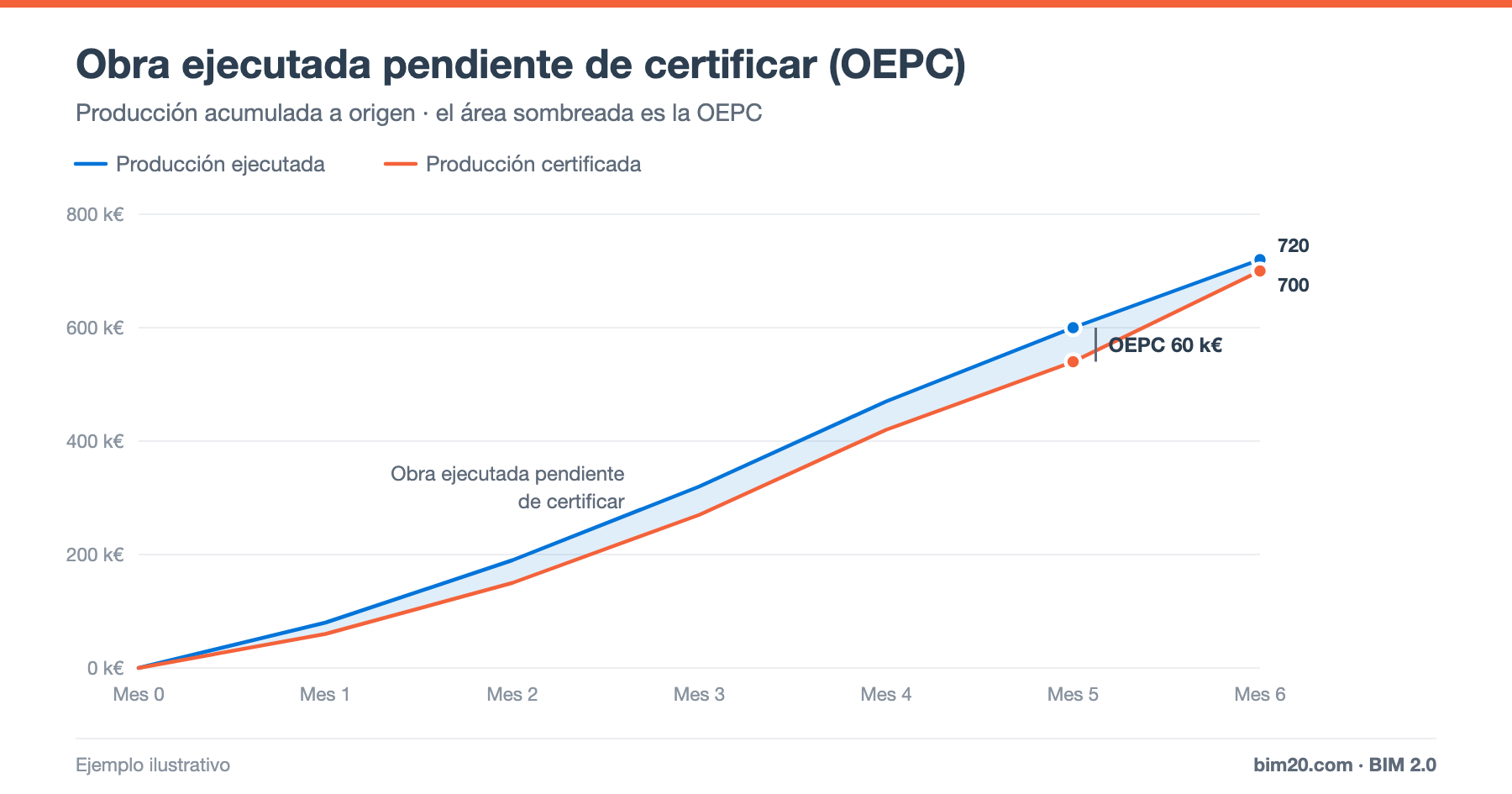
Work performed not yet certified (in Spanish, obra ejecutada pendiente de certificar, OEPC; also known as unbilled work or underbilling) is the part of the project that has already been built but has not yet been included in any certification to the client. It is a key concept in a contractor's financial management because it affects three things at once: margin, cash flow and accounting.
How it is calculated
OEPC = cumulative executed production − cumulative certified production
Where:
- Executed production: work actually built, valued at contract prices.
- Certified production: work included in the certifications issued.
Example
In month 5 of a project:
- Cumulative executed production: €600,000
- Cumulative certified production: €540,000
- OEPC = €60,000 (10% of what has been executed)
In month 6, after a more complete certification, executed production is €720,000 and certified production is €700,000: the OEPC drops to €20,000.
Why OEPC appears
- Timing gap: the certification is closed on a given date while the work keeps progressing.
- Units still to be measured or approved by the project supervision team.
- Additional works without an approved contradictory price.
- Measurement disagreements with the client.
- Payment milestones not reached even though part of the phase has been executed. See payment milestones.
- Administrative delays in issuing the certification.
Why it matters
For margin
Project margin must be calculated on executed production, not certified production. If OEPC is ignored, the month's margin looks worse than it is (the entire cost is compared with only part of the sales). See project margin.
For cash flow
OEPC is money the company has spent and cannot yet invoice. The larger it is, the greater the need for financing. See project cash flow.
For risk
An OEPC that grows month after month is a warning sign: it may be hiding work that the client will not acknowledge. The older it is, the harder it is to collect.
For accounting
In contractors' accounting, the accounting rules allow revenue to be recognized according to the percentage of completion when certain requirements are met. In that case, OEPC is recorded as a receivable from the client, even though it has not been invoiced. Check with your advisor for the specific treatment in your company.
The opposite case: over-certification
If more has been certified than has been executed (because of advances, early milestones or generous measurements), the difference is over-certification or advance billing. It improves short-term cash flow, but:
- It inflates the apparent margin if it is calculated on what has been invoiced.
- It is deducted from later certifications.
- In accounting terms it is generally treated as an obligation to the client rather than as revenue (check with your advisor).
Indicators to control it
- OEPC in euros per project and for the whole company.
- OEPC / monthly production: how many months of production are pending certification.
- Age of OEPC: what share is more than 60 or 90 days old.
- OEPC by cause: normal timing gap, pending price, under dispute.
Include them in the project dashboard alongside the most widely used construction KPIs.
How to reduce it
- Measure the executed work at the close of each month, using criteria agreed with the project supervision team.
- Certify cumulatively (each certification accumulates everything executed since the start and deducts what has already been certified), so that anything not included one month goes into the next. See progress certification.
- Process contradictory prices as soon as new works appear.
- Document additional works with photos, reports and minutes.
- Review OEPC monthly for each project at the closing meeting.
Frequently asked questions
Is it normal to have OEPC?
Yes, there is always some gap between what has been executed and what has been certified. The problem is when it grows or ages.
Are OEPC and earned value the same thing?
No. Earned value values executed work at planned cost; OEPC compares executed and certified work at selling price. See earned value analysis.
Conclusion
Work performed not yet certified is the boundary between what has been built and what can be collected. Measuring it every month, understanding its causes and reducing it improves cash flow and gives a faithful picture of project margin.
👉 With BIM 2.0 for Odoo, progress, certifications and invoicing share the same budget, so the difference between executed and certified work is visible at all times. Request a demo.