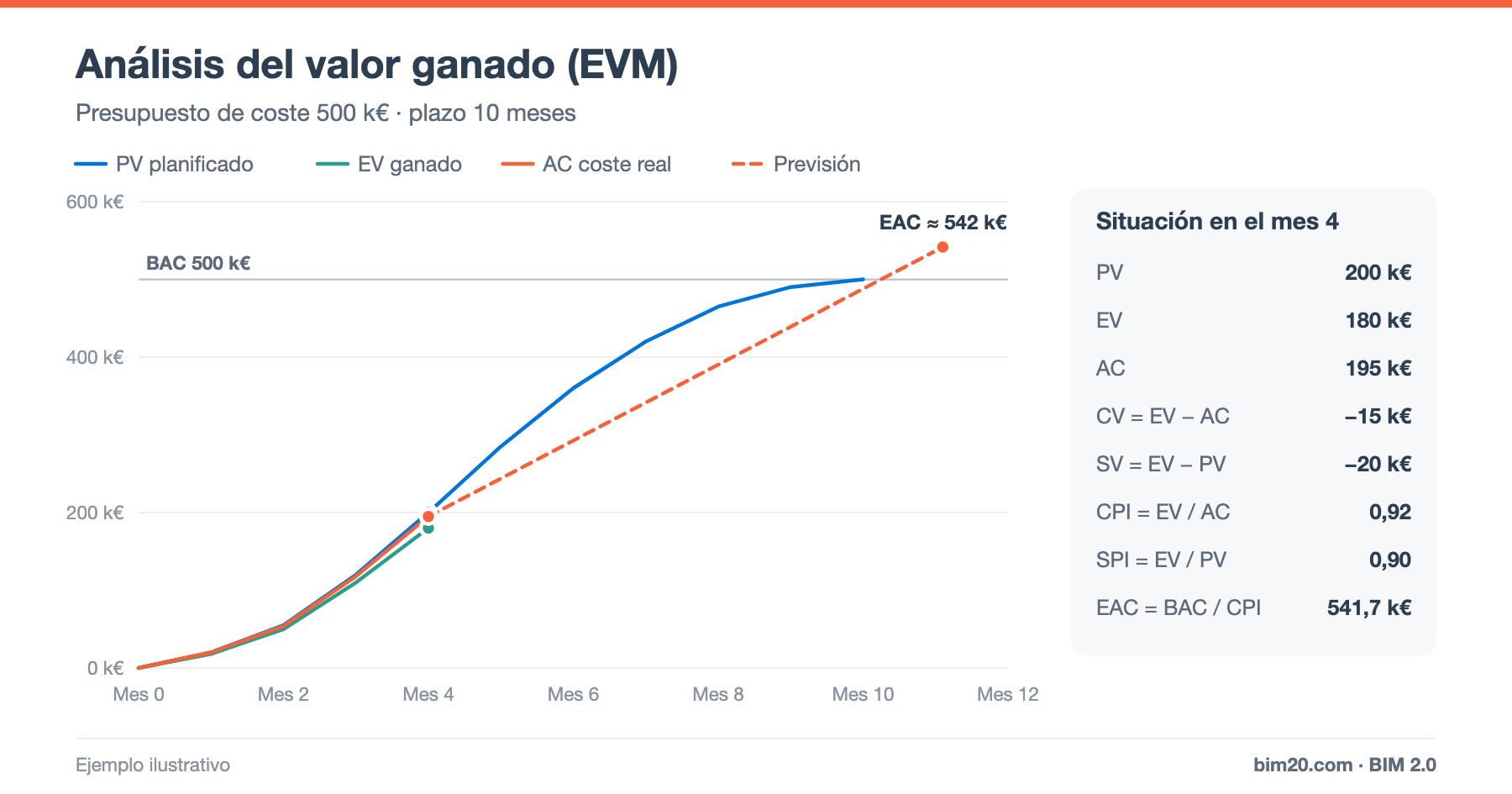
Earned value analysis (Earned Value Management, EVM) is one of the most complete techniques for controlling a project's cost and schedule at the same time. It answers two questions every site manager asks each month: am I spending more than I should for what I have done? and am I behind schedule?
Its great advantage is that it measures everything in the same unit (euros), which makes it possible to compare schedule and cost on a single chart.
The three basic values
PV – Planned Value
The budgeted cost of the work that should be done at the control date according to the schedule. Accumulated over time, it is the planned cost S-curve.
EV – Earned Value
The budgeted cost of the work actually performed. It is calculated by multiplying the actual progress of each line item by its planned cost:
EV = Σ (quantity performed × planned unit cost)
AC – Actual Cost
What has actually been spent on the work performed: purchases, subcontractors, labor, equipment and overheads charged to the project.
BAC – Budget at Completion
The total cost budget of the project. It is the final value of the PV curve.
The variances
- CV – Cost Variance = EV − AC. Negative → cost overrun.
- SV – Schedule Variance = EV − PV. Negative → delay (expressed in euros of output).
The indices
- CPI – Cost Performance Index = EV / AC. How many euros of work you get for each euro spent.
- SPI – Schedule Performance Index = EV / PV. What share of the plan has been completed.
An index equal to 1 means the plan is being met; below 1, the project is doing worse than planned. We analyze them in depth in CPI and SPI: how to interpret them.
The forecast
- EAC – Estimate at Completion = BAC / CPI (if the current cost performance continues).
- ETC – Estimate to Complete = EAC − AC.
- VAC – Variance at Completion = BAC − EAC.
There are other EAC formulas depending on the assumption adopted. We compare them in EAC, ETC, VAC and TCPI.
Full example
A project with a cost budget (BAC) of €500,000 and a duration of 10 months. At month 4:
- PV = €200,000 (according to the schedule, work at that cost should have been completed).
- EV = €180,000 (the work actually performed, valued at planned cost).
- AC = €195,000 (what was actually spent).
Calculations:
- CV = 180,000 − 195,000 = −€15,000 → cost overrun.
- SV = 180,000 − 200,000 = −€20,000 → delay.
- CPI = 180,000 / 195,000 = 0.92 → for every euro spent, €0.92 of work is produced.
- SPI = 180,000 / 200,000 = 0.90 → 90% of the plan has been completed.
- EAC = 500,000 / 0.9231 ≈ €541,667.
- ETC = 541,667 − 195,000 ≈ €346,667.
- VAC = 500,000 − 541,667 ≈ −€41,667.
Interpretation: if nothing changes, the project will end up costing about €41,700 more than planned and will finish late. It is time to act.
How to calculate EV in practice
Earned value is the most delicate figure, because it depends on measuring progress correctly:
- By quantities: quantity performed of each line item × planned unit cost. This is the most reliable method and is the same basis as progress certifications.
- By weighted milestones: a percentage is assigned to each activity's milestones.
- 50/50 or 0/100 rule: for short activities, 50% is credited at the start and 50% at completion, or 0% until completion.
Never use the percentage of cost spent as progress: if you do, EV will equal AC, CPI will always be 1 and the method loses all its value.
Common mistakes
- Using selling prices for EV and actual costs for AC: this mixes margin with variance. EV and PV must be calculated at planned cost.
- Posting costs to the project late (for example, invoices that arrive two months later): AC is understated and CPI looks better than it is. Also record delivery notes and commitments.
- Changing the baseline every month, which makes periods impossible to compare.
- Not separating approved change orders, which must update the BAC.
Earned value and cost control
EVM does not replace line-item analysis; it complements it: the overall CPI tells you that there is a problem, and the price and quantity variance analysis tells you where and why. You will find the full process in how to control project costs.
Frequently asked questions
Is earned value useful for small projects?
Yes. All you need is a cost budget, a basic schedule, progress measurements and costs charged by project.
How often is it calculated?
In construction it is usually monthly, coinciding with the certification.
Conclusion
Earned value analysis turns project tracking into three curves and a few indices that anyone can understand. Properly fed, it anticipates cost overruns and delays while they can still be corrected.
👉 BIM 2.0 for Odoo calculates the earned value method from the estimate, progress certifications and the actual costs recorded in the ERP. Request a demo.