Detecting that a project is spending more than planned is the first step. The second, and more useful, is knowing why. Variance analysis breaks each cost overrun into two causes: you paid more (price variance) or you used more quantity (usage variance).
Each cause has different owners and different solutions, which is why it pays to separate them.
The formulas
For a resource or line item:
- Planned cost (for work performed) = planned quantity × planned price
- Actual cost = actual quantity × actual price
- Total variance = actual cost − planned cost
It breaks down into:
- Price variance = (actual price − planned price) × actual quantity
- Usage variance = (actual quantity − planned quantity) × planned price
The sum of the two is exactly the total variance.
The planned quantity is not that of the full budget, but the one that corresponds to what has actually been built: quantity executed × planned productivity rate. Comparing against the total budget is a very common mistake.
Example: HA-25 concrete
Data:
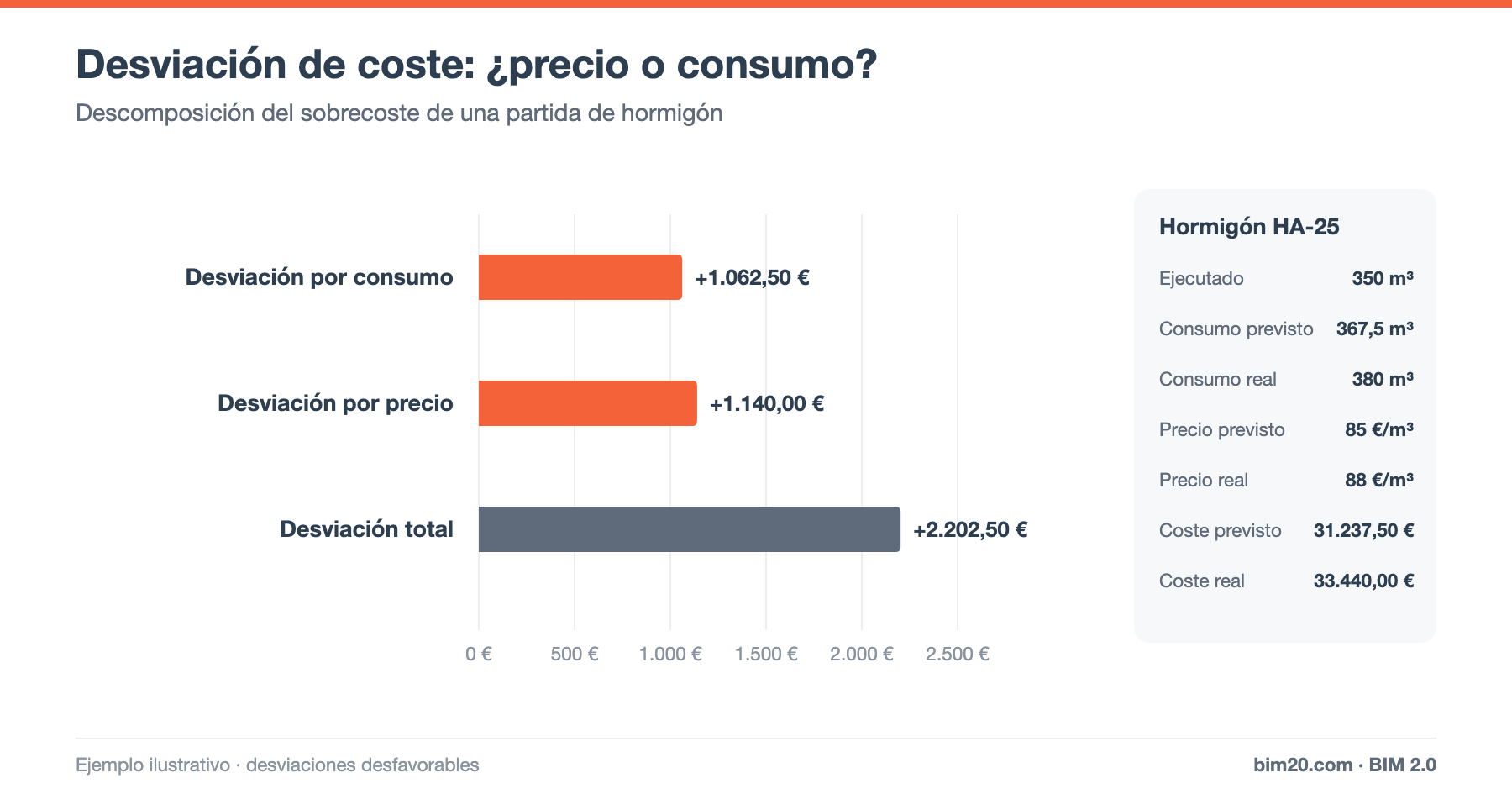
- Concrete placed (measured): 350 m³
- Planned rate: 1.05 m³ of concrete per m³ built (5% waste)
- Planned quantity = 350 × 1.05 = 367.5 m³
- Actual quantity (delivery notes): 380 m³
- Planned price: €85/m³
- Actual price: €88/m³
Calculation:
- Planned cost = 367.5 × 85 = €31,237.50
- Actual cost = 380 × 88 = €33,440.00
- Total variance = +€2,202.50 (unfavorable)
Breakdown:
- Price variance = (88 − 85) × 380 = +€1,140.00
- Usage variance = (380 − 367.5) × 85 = +€1,062.50
Check: 1,140.00 + 1,062.50 = €2,202.50. ✔
Slightly more than half of the overrun comes from price (52%) and the rest from usage (48%): there are two different problems to solve.
How to act on each variance
Price variance
Common causes:
- Outdated budget price or one taken from a generic price database.
- Purchases made without comparing quotes, or rush orders.
- Market increases not covered by price revision.
- Unplanned surcharges (pumping, night shifts, admixtures).
Actions:
- Negotiate framework agreements with suppliers.
- Compare at least three quotes for the main supplies. See subcontractor management and bid comparison.
- Apply price adjustment formulas when the contract allows it.
Usage variance
Common causes:
- Over-excavation or poor formwork that increases the volume of concrete.
- Losses, breakage and theft of material.
- Measurement or ordering errors.
- Labor productivity worse than planned. See labor productivity in construction.
Actions:
- Control the receipt of delivery notes and their allocation to line items.
- Review the work itself (setting out, formwork, stockpiles).
- Improve order planning and storage.
Variances in labor and subcontractors
The same logic applies to other resources:
- Labor: price = hourly cost; usage = hours per unit.
- Subcontractors: price = contracted unit price versus budgeted; usage = certified quantity versus quantity actually executed (for example, measurement overruns).
- Equipment: price = hourly rate; usage = hours of use per unit produced.
From line item to monthly report
A good variance report:
- Sorts line items by variance amount (not by percentage).
- Shows price and usage separately.
- Indicates whether the variance is one-off or recurring (whether it will repeat in the remaining work).
- Assigns an action and an owner.
Integrated with earned value analysis, it explains the project's CPI and feeds the forecast of final cost.
Frequently asked questions
Why is the price variance calculated with the actual quantity?
By convention: this way the two variances add up exactly to the total, and the usage variance is valued at the planned price, without mixing in the price effect.
What if I do not have actual usage by line item?
Start with the highest-value resources (concrete, steel, main subcontractors) and allocate their delivery notes to line items. See how to control construction costs.
Conclusion
Separating price variance from usage variance turns "we went over" into a specific diagnosis with owners and actions. It is the most practical tool for protecting margin line item by line item.
👉 In BIM 2.0 for Odoo, purchases, delivery notes and site reports are allocated to the budget line item, so you can compare planned against actual. Request a demo.