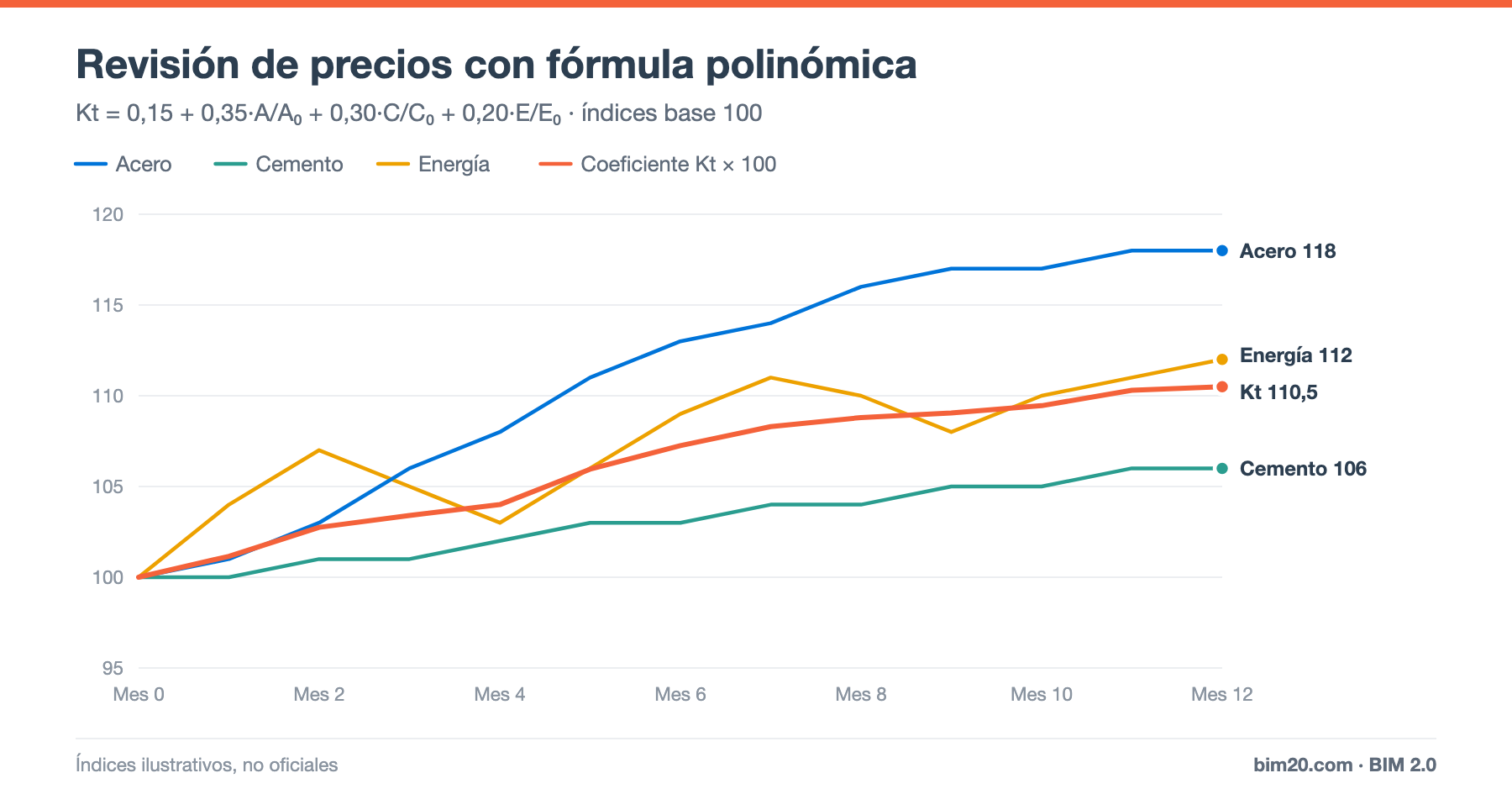
On long projects, the prices of materials, energy and labor change during execution. Polynomial price adjustment formulas (fórmulas polinómicas de revisión de precios) adjust the amount of progress certifications to that evolution objectively, using official indices instead of case-by-case negotiation.
What a polynomial formula is
It is an expression that calculates a revision coefficient Kt as a weighted sum of the variation of several price indices:
Kt = a + b · (Aₜ / A₀) + c · (Cₜ / C₀) + d · (Eₜ / E₀) + …
Where:
- a is a fixed term, representing the part of the price that is not adjusted.
- b, c, d… are the weights of each component (steel, cement, energy, labor…).
- Aₜ / A₀ is the ratio between the component's index at the time of execution (t) and at the reference time (0), normally the bid or award date.
- The sum of all coefficients (a + b + c + d + …) is 1.
The adjusted amount is obtained by multiplying the period's certification by Kt:
Adjusted amount = certified amount × Kt
Adjustment = certified amount × (Kt − 1)
Example
Contract formula:
Kt = 0.15 + 0.35 · A/A₀ + 0.30 · C/C₀ + 0.20 · E/E₀
(A = steel, C = cement, E = energy)
Indices in month 12 (base 100 at award):
- Steel: 118
- Cement: 106
- Energy: 112
Calculation:
- Kt = 0.15 + 0.35 × 1.18 + 0.30 × 1.06 + 0.20 × 1.12
- Kt = 0.15 + 0.413 + 0.318 + 0.224 = 1.105
If the month 12 certification amounts to €50,000, the price adjustment is:
50,000 × (1.105 − 1) = €5,250 in favor of the contractor.
Note that Kt (1.105, i.e. an increase of 10.5%) is below the increase in steel (18%) and above the increase in cement (6%): it reflects the weight of each material in the project and the fixed, non-adjustable part.
How the coefficients are chosen
The weights must reflect the real cost structure of the project:
- A steel-structure project will have a high weight on steel.
- A civil works (urbanization) project will weigh more on bitumen, aggregates and energy.
- A refurbishment project will weigh more on labor.
In public procurement, standard formulas officially approved for each type of work are usually used, and the tender specifications indicate which one applies.
General framework in Spain
In Spanish public procurement, price revision is regulated by Law 9/2017 on Public Sector Contracts (articles 103 onward), and the standard formulas for works were approved by Royal Decree 1359/2011. In general:
- The revision must be provided for in the tender specifications.
- A minimum percentage of executed work and a period since the contract was formalized are usually required before a revision applies.
- Official price indices for materials, published periodically, are applied.
This regulation has been amended and subject to exceptional measures in recent years, so always check the version in force and the specific tender documents of each contract.
In Latin America
Polynomial adjustment formulas are very common in several countries. In Peru, for example, they have been regulated for decades and are calculated with unified construction price indices published officially; estimating programs such as S10 allow applying them. Each country has its own regulations and indices.
Price adjustment formulas in private projects
They are not mandatory in private projects, but they can be agreed in long contracts or where volatile materials weigh heavily. Common alternatives:
- Fixed price with a built-in risk margin.
- Adjustment of specific materials only (steel, copper) against a reference index.
- Adjustment clauses triggered above a variation threshold.
Impact on project control
- When estimating, the price must reflect whether there will be an adjustment or not: without one, the risk of price increases is borne by the contractor.
- In the variance analysis, the price variance on materials can be partly offset by the adjustment.
- The adjustment is added to production for purposes of project margin and certification.
Common mistakes
- Using indices from the wrong base date.
- Applying Kt to work that is not subject to adjustment (for example, variation prices with their own date).
- Not adjusting on time: often the adjustment is claimed at the end, which complicates collection.
- Coefficients that do not reflect the real project.
Frequently asked questions
Can the adjustment be negative?
Yes. If the indices fall relative to the base date, Kt is below 1 and the amount payable decreases.
What does the fixed term mean?
It represents the part of the price that is not updated, that is, the part the contract sets as non-adjustable.
Conclusion
Polynomial formulas allocate the risk of price variation between client and contractor objectively. Understanding how Kt is calculated and applying it correctly in each certification protects your margin on long projects.
👉 BIM 2.0 for Odoo lets you link polynomial formulas to project certifications. Request a demo.