Project margin is the difference between what is sold (what the client pays) and what it costs to build the project. It is the indicator that sums up whether a project is profitable and, added across all projects, whether the company is.
It looks simple, but there are several ways to calculate it and they are easy to confuse. Here we put them in order with an example.
Basic concepts
- Sales (output): value of the work performed at contract prices (excluding VAT).
- Project cost: materials, subcontractors, own labor, equipment and the project's indirect costs.
- Company overheads: central structure (offices, management, administration, sales) that does not belong to any specific project.
Gross project margin
Gross margin = sales − project cost
Gross margin (%) = gross margin / sales
This is the margin the project generates to cover the company's structure and make a profit. It is the one tracked project by project.
Net margin
Net margin = gross margin − proportional share of company overheads
This is what the company actually earns on that project after paying for its structure (before taxes and, depending on the case, financial expenses).
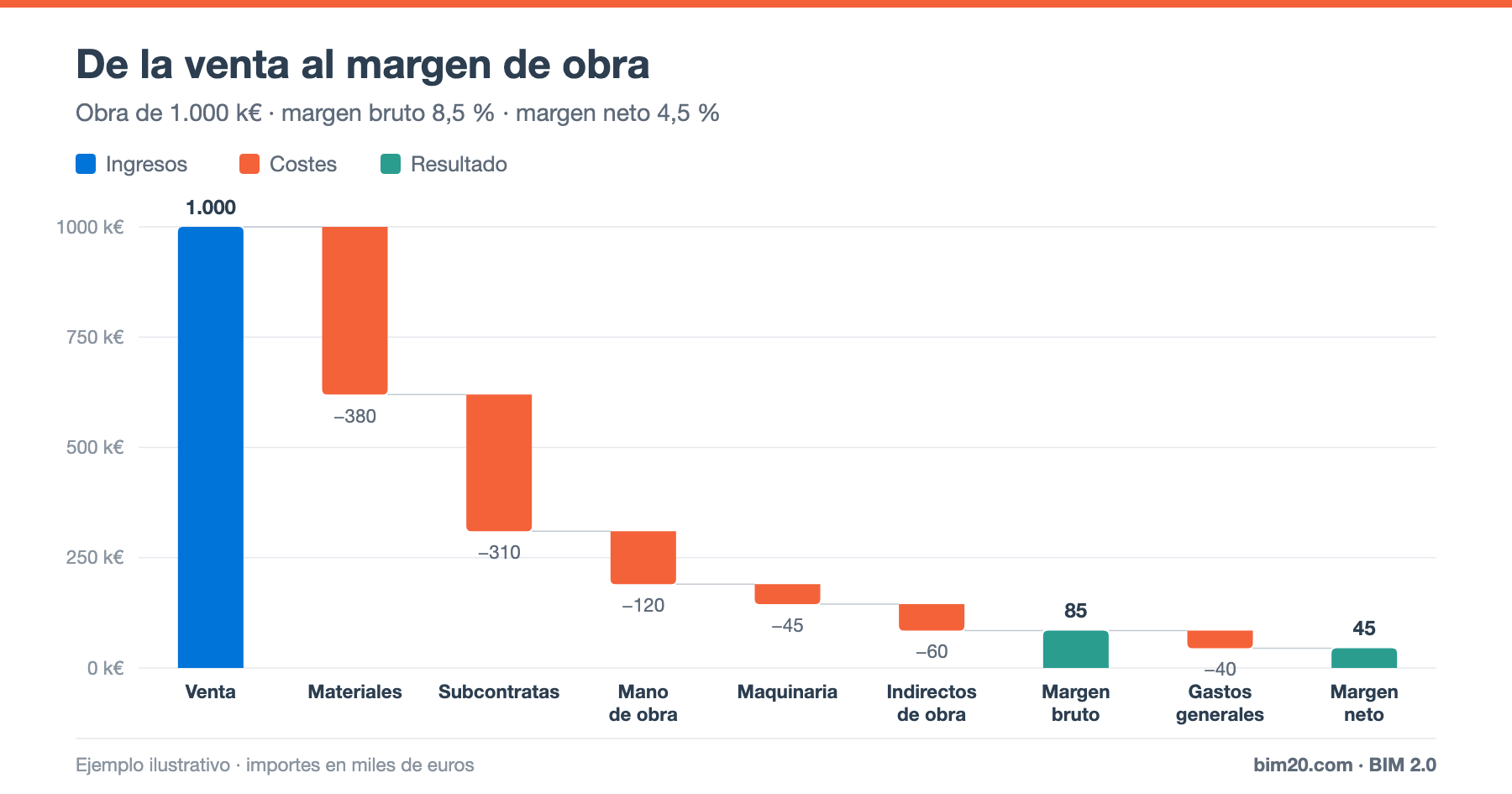
Waterfall example
A project with sales of €1,000,000:
- Sales: €1,000k
- Materials: −€380k
- Subcontractors: −€310k
- Own labor: −€120k
- Equipment: −€45k
- Project indirect costs: −€60k
- Gross margin: €85k (8.5%)
- Allocated company overheads: −€40k
- Net margin: €45k (4.5%)
In a waterfall chart it is easy to see where the sales revenue "goes": here, 69% between materials and subcontractors (€690k). Any variance in those two blocks has a large impact on the margin.
Margin on sales vs markup on cost
This is a very common confusion. Using the example above (project cost of €915k and margin of €85k):
- Margin on sales = profit / sales = 85 / 1,000 = 8.5%
- Markup on cost = profit / cost = 85 / 915 = 9.3%
If you want an 8.5% margin on sales, it is not enough to add 8.5% to cost: you would have to add 9.3%. The relationship is:
Markup = margin / (1 − margin)
Planned, actual and end-of-project margin
- Planned margin (estimate): the one in the bid estimate.
- Target margin: the one in the cost budget after award (with real subcontractor quotes).
- Actual margin to date: work performed − actual cost to date.
- End-of-project margin: forecast final sales − forecast final cost (EAC).
Monthly monitoring compares these four values. If the actual margin to date is lower than the target, analyze why with the variance analysis.
Margin is calculated on work performed, not on amounts invoiced
A common mistake is to calculate margin from what has been invoiced to the client. If invoicing lags behind execution, the margin looks worse; if it is ahead, it looks better. The right basis is work performed, which includes work performed not yet certified.
Likewise, cost must include everything consumed, even if the supplier's invoice has not arrived yet (pending delivery notes).
What margin is reasonable in construction
It depends heavily on the type of project, the client and the market. As an order of magnitude, in building construction gross margins tend to be moderate and net margin narrow. That is why a variance of just a few points in materials or subcontractors can push a project into losses.
To find out what gross margin you need, calculate your break-even point: the company's overheads must be covered by the margin of all its projects.
How to protect the margin
- Estimate with unit prices and realistic productivity rates.
- Close critical subcontracts and purchases early and below the cost budget.
- Monitor actual versus planned cost every month.
- Claim changes from the client and formalize agreed prices for unforeseen work.
- Control indirect costs and the schedule.
Frequently asked questions
Does project margin include overheads?
Gross margin does not; net margin does. In public tenders, overheads and contractor's profit are usually added on top of the PEM (material execution budget, the direct cost of the works). See overheads and contractor's profit.
How do I allocate overheads across projects?
The most common approach is in proportion to each project's output, although another criterion can be used if it is applied consistently.
Conclusion
Calculating project margin properly requires separating project costs from structural expenses, distinguishing margin from markup and always comparing against work performed. With that discipline, margin becomes the indicator that guides all of management.
👉 BIM 2.0 for Odoo shows sales, actual cost and margin for each project using data from purchasing, site reports and certifications. Request a demo.