A unit price analysis (UPA) is the calculation that explains how much it costs to build one unit of a line item: a cubic meter of concrete, a square meter of flooring or one door. In Spain it is also called a precio descompuesto (unit cost breakdown).
Mastering the UPA is essential for estimating accurately, justifying change-order prices and checking whether a line item is making or losing money on site.
What is a UPA
A UPA breaks down the price of a line item into the resources needed to produce one unit:
- Labor: skilled workers, assistants, laborers.
- Materials: concrete, steel, bricks, mortar, pipes…
- Equipment: crane, pump, backhoe, vibrator…
- Auxiliary means: small tools and non-measurable items, normally as a percentage.
- Indirect costs: jobsite costs that cannot be charged to a specific line item (site cabins, foreman, security), as a percentage.
Each resource is expressed with a productivity rate (quantity needed per unit of line item) and a price (cost per unit of resource).
The unit price formula
The calculation always follows the same logic:
- Cost of each resource = rate × resource price.
- Direct cost = labor + materials + equipment.
- Auxiliary means = % × direct cost.
- Indirect costs = % × (direct cost + auxiliary means).
- Unit price = direct cost + auxiliary means + indirect costs.
Overheads, contractor's profit and VAT are then applied to the total of the estimate (not to each line item), as explained in how to build a construction budget step by step.
A practical UPA example
Line item: m³ of HA-25/B/20/IIa concrete in foundation footings, pumped and vibrated.
Resources (sample prices):
- Skilled worker: 0.10 h × €22.50/h = €2.25
- Laborer: 0.30 h × €19.00/h = €5.70
- HA-25/B/20/IIa concrete: 1.05 m³ × €85.00/m³ = €89.25
- Concrete pump: 0.05 h × €120.00/h = €6.00
- Poker vibrator: 0.10 h × €4.00/h = €0.40
Calculation:
- Direct cost: €103.60
- Auxiliary means (2%): €2.07
- Subtotal: €105.67
- Indirect costs (6%): €6.34
- Unit price: €112.01/m³
Note two details:
- The concrete rate is 1.05 m³, not 1.00: it includes 5% waste.
- Labor and equipment are expressed in hours per m³, a figure that depends on the crew's actual productivity.
How to obtain productivity rates
Rates are the most delicate part of a UPA. You can get them from:
- Official price databases: Base de Precios de la Construcción de Guadalajara, BEDEC (ITeC), Base de Costes de la Construcción de Andalucía (BCCA), IVE, CYPE's Generador de Precios… (Spanish construction price databases).
- Your company's historical data: work reports and actual consumption from previous projects.
- Subcontractor bids: when the line item is subcontracted at a fixed price.
Ideally you start from a price database and adjust it with your own actual data. A construction ERP makes this adjustment easier, because it records hours and consumption per line item on every project.
How to calculate the price of each resource
- Labor: gross salary + employer social security contributions + allowances, divided by the effective annual hours.
- Materials: delivered-to-site price (including transport and unloading).
- Equipment: depreciation, maintenance, fuel, insurance and operator.
You will find the detailed calculation with examples in how to calculate materials, labor and equipment for a project.
Auxiliary means and indirect costs
Auxiliary means
They are usually set between 1% and 3% of the direct cost. They cover hand tools, small materials and means that are not measured in other line items.
Indirect costs
In Spain, the indirect cost percentage is calculated as the ratio between the project's estimated indirect costs and its total direct cost. In building construction it is typically around 5-6%, although it depends on the type and duration of the project. It includes:
- Technical staff and site foreman.
- Site cabins, temporary facilities and utilities.
- Security, cleaning and small shared means.
Common mistakes in a UPA
- Copying productivity rates without reviewing them: a price database reflects an average, not your productivity.
- Forgetting waste: concrete, ceramics, mortar and insulation always have losses.
- Duplicating costs: including the crane in every line item and also in indirect costs.
- Not updating prices: material prices change within a few months. If your contracts allow it, apply price adjustment formulas.
- Mixing units: hours versus days, kg versus tons.
UPA in BIM 2.0 for Odoo
In BIM 2.0, unit prices are managed as reusable records with their resources (labor, materials, equipment and subcontracts). This allows you to:
- Use the same UPA in different estimates and copy resources between estimates.
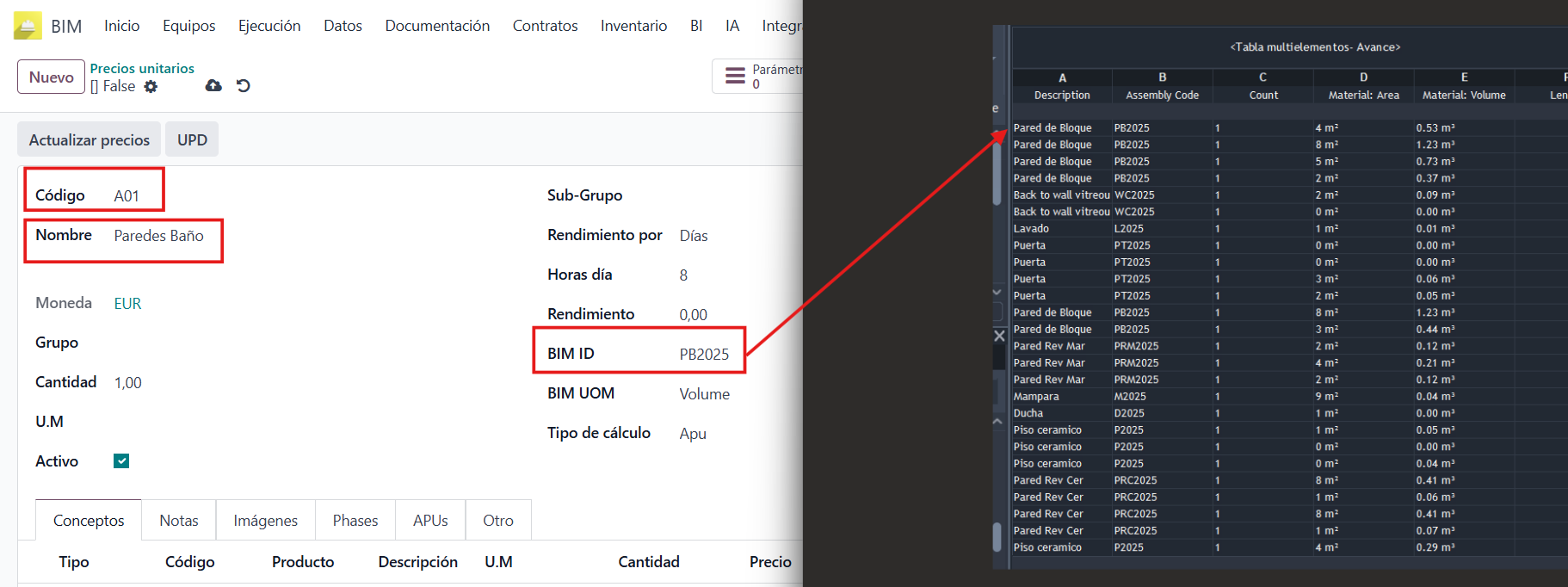
- Link each UPA to a BIM model element through its code to import quantities from Revit.
- Compare on site the planned cost of the UPA with the actual cost recorded in purchases and work reports.
- Analyze the technical-economic indicators (ITE) of each project.
Frequently asked questions
What is the difference between a unit price and a unit cost breakdown?
In practice they are the same thing: the unit cost breakdown (precio descompuesto) is the unit price showing its breakdown into resources.
Does a UPA include overheads and contractor's profit?
Normally not. The UPA goes up to indirect costs; overheads and contractor's profit are then applied to the total material execution budget (PEM, the sum of all direct and indirect costs).
What is a change-order price?
It is a new price agreed during construction for a unit not foreseen in the estimate (in Spain, a "precio contradictorio"). It is justified precisely with a UPA.
Conclusion
Unit price analysis is the foundation of the estimate. If your UPAs are realistic, your estimate will be competitive and your cost control more reliable.
👉 Download the Comprehensive Construction Budgeting Manual (in Spanish) or request a BIM 2.0 demo.