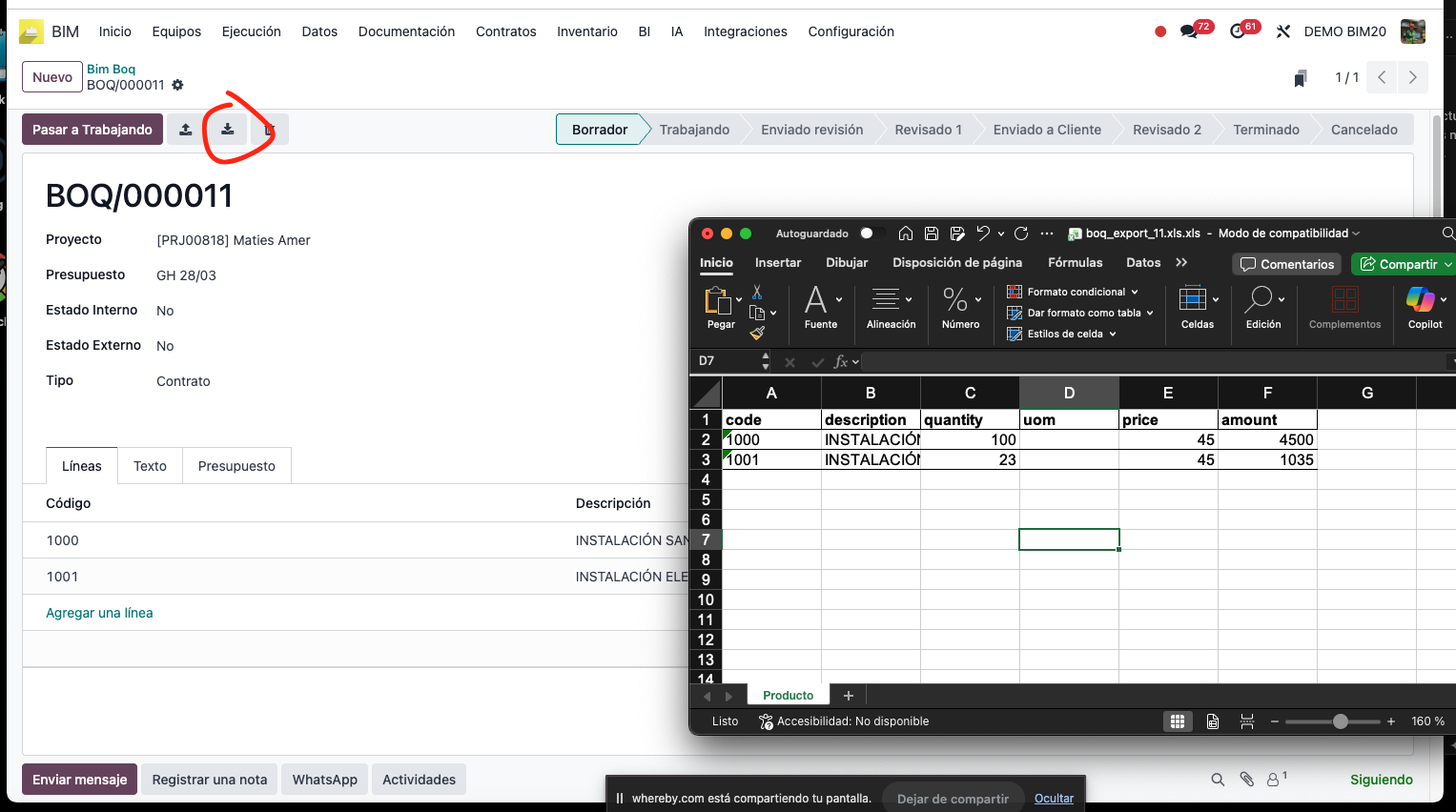
Knowing how to prepare a construction budget is one of the most important skills for any technician or contractor. A good budget does not only help you win a tender: it is the foundation for controlling costs, schedules and margins throughout execution.
This guide walks through the whole process, from reading the project documents to the final contract price, with a practical example.
What is a construction budget
A construction budget is a document that puts a price on all the work needed to carry out a project. It is organized into sections and line items, and each line item has a unit of measure, a quantity (measurement) and a unit price.
Key concepts:
- Section (capítulo): a group of line items by type of work (earthworks, foundations, structure, masonry…).
- Line item (partida): a specific unit of work, for example "m² of ceramic brick masonry".
- Measurement: the quantity of each line item.
- Unit price: the cost of one unit of the line item, obtained from its unit price analysis (UPA).
- PEM (Presupuesto de Ejecución Material): the direct execution cost, i.e. the sum of all line items.
- PEC (Presupuesto de Ejecución por Contrata): the contract execution price, i.e. the PEM plus overheads and contractor's profit.
In the English-speaking world, this document is equivalent to the BOQ or Bill of Quantities.
Step 1: Study the project and define the scope
Before measuring anything, read the project report, the drawings, the specifications and, if there is one, the BIM model. You need to answer:
- What is and is not included in the assignment?
- What quality levels and specifications do the specifications require?
- Are there site constraints (access, storage, neighbors, working hours)?
- What is the expected duration?
A scope error at this stage carries through the entire budget.
Step 2: Define the section structure
A typical structure for building works is:
- Preliminary works and demolition
- Earthworks
- Foundations
- Structure
- Roofing
- Facades and partitions
- Services (plumbing, drainage, electrical, HVAC)
- Insulation and waterproofing
- Finishes and coatings
- Carpentry and metalwork
- Site development
- Waste management
- Quality control
- Health and safety
Always using the same structure makes it easier to compare projects and reuse historical data.
Step 3: Write the line items
Each line item must have:
- A unique code.
- A unit (m, m², m³, kg, unit, lump sum).
- A complete description: what it includes, materials, equipment and measurement criteria.
An ambiguous description leads to disputes on site. "Brick masonry" is not enough; "m² of half-brick-thick wall in perforated brick 24×11.5×9 cm, laid in M-7.5 mortar, including setting out, leveling and plumbing" is.
Step 4: Take off the quantities
The measurement is the quantity of each line item according to the drawings or the model. You can measure:
- Manually, on PDF or CAD drawings, using measurement lines (units, length, width, height).
- From Excel, if you already have calculated quantities. We explain it in construction budget in Excel.
- From the BIM model, extracting quantities from Revit or IFC. See 5D BIM estimates from Revit and IFC.
Tip: always keep the measurement lines on record. When you need to certify or justify an excess, you will know where each number comes from.
Step 5: Calculate the unit prices
Each unit price is obtained by adding up the resources needed to build one unit:
- Labor: hours × hourly cost.
- Materials: quantity × price (including waste).
- Equipment: hours × hourly cost.
- Auxiliary means: a percentage on the items above.
- Indirect costs: a percentage on the direct cost.
You can start from a price database (the Guadalajara Construction Price Base, BEDEC, the Andalusian Construction Cost Base, CYPE's Price Generator…) and adjust it to your actual costs. The detailed calculation is in how to calculate materials, labor and equipment.
Step 6: Obtain the PEM
The PEM (direct execution cost) is the sum of (measurement × unit price) for all line items.
Simplified example:
- Excavation: 120 m³ × €8.50 = €1,020.00
- Concrete in footings: 35 m³ × €112.01 = €3,920.35
- Brick masonry: 450 m² × €28.40 = €12,780.00
- Rendering: 900 m² × €14.20 = €12,780.00
PEM = €30,500.35
Step 7: Add overheads, contractor's profit and VAT
The following are applied on top of the PEM:
- Overheads (gastos generales, GG): company expenses that cannot be charged to a specific line item (offices, management, insurance, financial costs). In Spanish public works they are usually set between 13% and 17%.
- Contractor's profit (beneficio industrial, BI): usually 6% of the PEM in public works.
- VAT (IVA): according to the applicable rate (21% standard, 10% for certain housing works).
Following the example with 13% overheads and 6% profit:
- PEM: €30,500.35
- Overheads (13%): €3,965.05
- Profit (6%): €1,830.02
- PEC (excluding VAT): €36,295.42
- VAT (21%): €7,622.04
- Total including VAT: €43,917.46
Step 8: Review and validate
Before submitting the bid:
- Compare ratios (€/m² built) with similar projects.
- Review the highest-value line items: a few items usually concentrate most of the total amount.
- Check that no mandatory sections are missing (waste, health and safety, quality control).
- Validate the prices of critical materials against real quotes from suppliers and subcontractors. The guide to subcontractor management and bid comparison will help.
Step 9: Turn the budget into your control tool
The most common mistake is to file the budget away once the contract is awarded. In reality, it is the starting point for:
- Planning purchasing and subcontracting.
- Monitoring the project.
- Issuing progress certifications.
- Controlling costs and detecting variances.
With BIM 2.0 for Odoo, the budget becomes the project itself, with its line items, resources and planned costs ready to be compared with actual cost. To see it in practice, read how to create a BOQ in Odoo.
Common mistakes when preparing a construction budget
- Copying prices from a price database without adjusting them to the company's reality.
- Forgetting waste, shrinkage and auxiliary means.
- Ambiguous line item descriptions.
- Not including indirect site costs (site huts, crane, foreman, security).
- Not keeping traceability of the measurements.
Frequently asked questions
What is the difference between PEM and PEC?
The PEM is the cost of executing the line items. The PEC adds the contractor's overheads and profit.
What software should I use to prepare a construction budget?
It depends on your profile. You will find a comparison in the 10 best construction estimating programs.
Is there a downloadable guide?
Yes, you can download our Comprehensive Construction Budgeting Manual for free (in Spanish).
Conclusion
Preparing a construction budget is an orderly process: scope, structure, line items, measurements, prices, PEM and PEC. If you also connect it to execution, it stops being a sales document and becomes the main control tool for your project.
👉 Contact us and we will show you how to do it with BIM 2.0.