A progress certification (certificación de obra) is the document that records the work executed during a period and its economic value. It is the basis on which the contractor invoices and gets paid, which makes it one of the most important documents for a construction company's cash flow.
This guide explains what it is, what it contains and how to prepare one step by step, with a numerical example.
What a progress certification is
A certification is a valuation of the work actually executed, based on the contract quantities and prices. Typically:
- It is issued monthly.
- It is prepared cumulatively (everything executed since the start) and the previously certified amount is deducted.
- It is signed by the design team (or the client's representative) and accepted by the contractor.
- It is a payment on account: it is adjusted in the final settlement.
For public works in Spain, Law 9/2017 on Public Sector Contracts (LCSP) and its implementing regulations provide that the contracting authority issues certifications, normally monthly, for the work executed in each period.
Documents that make up a certification
- Valuation statement (relación valorada): cumulative executed quantities of each line item multiplied by their price.
- Certification: economic summary with the cumulative amount, the previous amount and the amount for the period.
- Summary by section.
- Appendices: approved non-contract prices, price revisions, photo report.
Step 1: Measure the work executed to date
For each line item, measure the quantity actually executed from the start until the certification date. Measurements must:
- Follow the measurement criteria of the project or contract.
- Be justified with measurement lines (location, dimensions).
- Be verifiable by the design team.
If you work with BIM, progress can be recorded in the model and brought into the ERP. With BIM 2.0 you can import certifications from Revit, as explained in Revit and Odoo ERP.
Step 2: Value the cumulative work
Multiply the cumulative quantity of each line item by its contract unit price. The total is the cumulative executed amount at execution (direct) cost level (ejecución material).
New, unforeseen units must be valued with approved agreed new prices (precios contradictorios).
Step 3: Deduct what was previously certified
Period certification = cumulative certification − previous certification
Always working cumulatively avoids accumulated errors: if too much was measured in one month, it is corrected automatically in the next.
Step 4: Apply overheads, contractor's profit and the award coefficient
In public works, the following are applied on top of the execution cost:
- Overheads (gastos generales, usually between 13% and 17%) and contractor's profit (beneficio industrial, 6%), according to the applicable regulations.
- Award coefficient: reflects the discount offered by the contractor. If the discount was 10%, the coefficient is 0.90.
In private works, the terms depend on the contract: you may certify directly at selling prices.
Step 5: Apply VAT and retention
- VAT at the applicable rate.
- Retention (holdback), common in private contracts (for example, 5%), returned at the end of the warranty period. In public works the guarantee is usually provided through a bank guarantee or deposit rather than withheld from each certification.
- Agreed deductions: advances, charges for shared services, penalties.
Progress certification example
Data:
- Cumulative execution cost: €120,000
- Execution cost previously certified: €85,000
- Overheads 13% + contractor's profit 6% (factor 1.19)
- Award discount of 10% (coefficient 0.90)
- VAT 21%
- Retention of 5% on the taxable base
Calculation:
- Execution cost for the period: 120,000 − 85,000 = €35,000.00
- With overheads and profit: 35,000 × 1.19 = €41,650.00
- With award coefficient: 41,650 × 0.90 = €37,485.00 (taxable base)
- VAT (21%): €7,871.85
- Total certification: €45,356.85
- Retention (5% of the base): −€1,874.25
- Net amount payable: €43,482.60
Subcontractor certifications
The same logic applies in reverse: the main contractor certifies to its subcontractors what they have executed. It is essential that the work certified to subcontractors is consistent with what is certified to the client, so you do not pay for work that has not yet been billed. See how to manage subcontractors.
Common mistakes when certifying
- Over-certifying to improve cash flow: it is deducted later and creates disputes.
- Under-certifying because measurements are not up to date: it hurts cash flow.
- Leaving out approved agreed new prices.
- Not applying price revisions (price adjustment formulas) when the contract provides for them.
- Disconnecting certification from cost control: certified production is the basis for calculating the real margin.
Certification as a control tool
Certification is not just a billing formality. Compared with the real cost of the period, it tells you whether the project is making money. That is why it should be tied to construction cost control and project monitoring.
Certifications with BIM 2.0 for Odoo
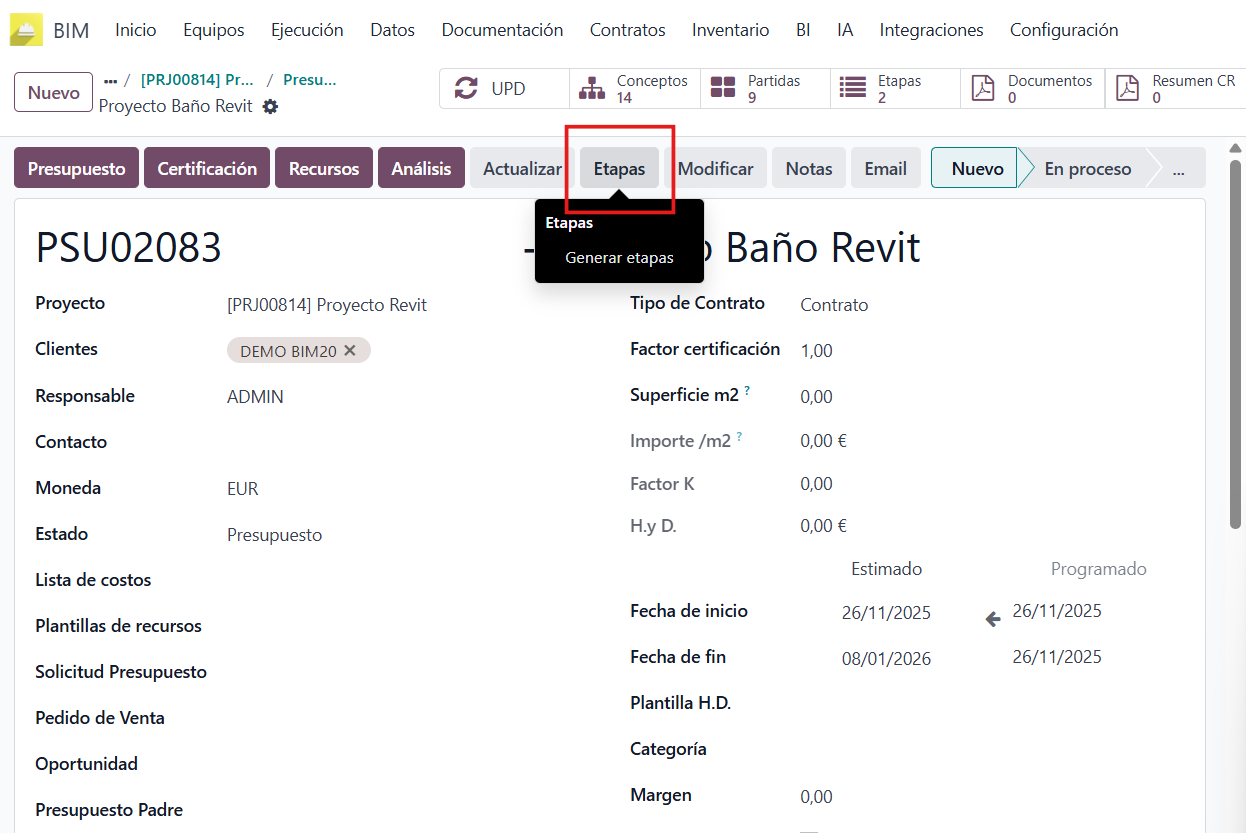
In BIM 2.0, progress certifications are generated from the project budget:
- Recording of cumulative quantities per line item.
- Automatic calculation of the previous and period certification.
- Payment statements and direct invoicing from the certification.
- Retention, indirect costs and price adjustment formulas (fórmulas polinómicas).
- Earned value and comparison with the real cost of the project.
Frequently asked questions
What is the difference between a certification and an invoice?
The certification records the work executed and its value; the invoice is the tax document issued on the basis of it.
Who signs the progress certification?
Normally the design team and the contractor. In public works, also the person designated by the contracting authority.
What is a cumulative certification?
It is the one that includes all the work executed since the start. The amount for the period is obtained by deducting the previous certification.
Conclusion
Preparing a progress certification correctly requires justified cumulative measurements, contract prices, and the correct application of coefficients, VAT and retention. Automating the process saves hours every month and improves cash flow.
👉 Find out how to certify with BIM 2.0 or request a demo.