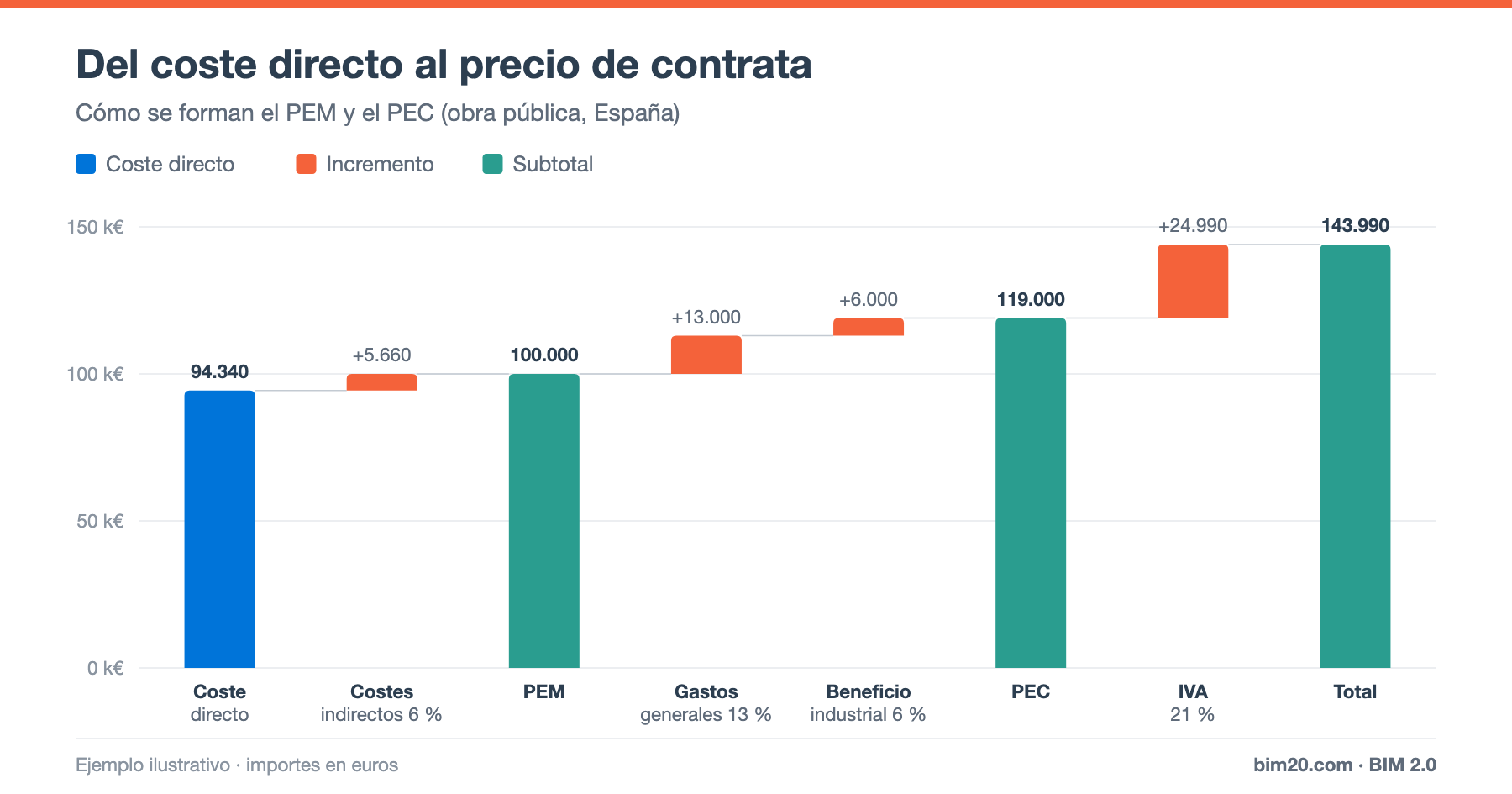
In a construction budget in Spain, two items are added on top of the Material Execution Budget (PEM, Presupuesto de Ejecución Material): overheads (GG, gastos generales) and contractor's profit (BI, beneficio industrial). The result is the Contract Execution Budget (PEC, Presupuesto de Ejecución por Contrata), to which VAT (IVA) is then added.
These items appear in every budget, but they are often applied without understanding what they cover. Let's look at what each one covers and how they are calculated.
From costs to price: the full chain
- Direct cost (CD): sum of the line-item costs. See direct and indirect costs.
- Indirect costs (CI): a percentage K on the direct cost.
- PEM = CD + CI
- Overheads (GG): a percentage of the PEM.
- Contractor's profit (BI): a percentage of the PEM.
- PEC = PEM + GG + BI
- VAT (IVA) on the PEC.
- Total budget = PEC + VAT
Numerical example
- Direct cost: €94,340
- Indirect costs (6%): +€5,660
- PEM: €100,000
- Overheads (13%): +€13,000
- Contractor's profit (6%): +€6,000
- PEC: €119,000
- VAT (21%): +€24,990
- Total: €143,990
What overheads are
Overheads cover company costs that cannot be charged to a specific project, plus certain expenses associated with the contract:
- Company structure costs: head office, management, administration, estimating department.
- Financial costs: cost of guarantees (bank bonds), financing the gap between payments and collections.
- Non-recoverable taxes, fees and licenses associated with the contract (as set out in the tender specifications).
- Other contract expenses: testing, advertising, general insurance.
Usual percentage
In Spanish public procurement, the General Regulation of the Public Administrations Contracts Act (Royal Decree 1098/2001) sets overheads between 13% and 17% of the PEM, depending on the circumstances of each project (always check the applicable regulations and tender specifications). In practice 13% is very common.
In private work there is no mandatory percentage: each company must calculate its own from its actual structure. A simple way is:
% GG = company's annual overheads / expected annual output
If structure costs are €600,000 and expected output is €6M, the overheads needed are 10%. If output falls to €4.5M, they rise to 13.3%. See break-even point.
What contractor's profit is
It is the profit the contractor expects to earn from carrying out the work. In Spanish public procurement, 6% of the PEM is usually taken.
In practice, the actual profit depends on:
- The discount offered in the tender, which reduces the price proportionally.
- Efficiency in execution: if the project costs less than budgeted, profit increases; if it costs more, it disappears.
That is why 6% is a budget concept, not a guarantee of profit. Actual profit is measured with the project margin.
GG and BI in certification
In Spanish public works, progress certifications apply to the material execution the same GG and BI factor (1.19 with 13% + 6%) and the award coefficient that reflects the discount.
Certified amount (excluding VAT) = material execution × 1.19 × award coefficient
Common mistakes
- Applying GG and BI on the PEC or on the total including VAT: they apply on the PEM.
- Calculating BI on (PEM + GG): in the Spanish system both are calculated on the PEM.
- Using 13% "just because" in private work without checking whether it covers the company's real structure.
- Duplicating costs: including in overheads costs that are already in the project's indirect costs.
- Forgetting the financial cost on projects with long payment terms. See project cash flow.
Frequently asked questions
What is the difference between PEM and PEC?
The PEM is the cost of carrying out the work (direct + indirect). The PEC adds the contractor's overheads and profit.
Is VAT applied on the PEM or on the PEC?
On the PEC.
Can I change the overheads percentage in a public tender?
Normally not: it is set by the contract specifications within the regulatory range. Your competitiveness lies in the discount you offer.
Conclusion
Overheads and contractor's profit turn the cost of the work into a price. Understanding what each one covers and calculating your own percentages in private work avoids working without covering the company's structure.
👉 Download the Comprehensive Construction Budgeting Manual (in Spanish) or request a BIM 2.0 demo.