Classifying costs correctly is the basis of any estimate and any financial control. In construction there are three levels: direct costs, project indirect costs and company overheads. Confusing them leads to miscalculated estimates, duplicated costs or margins that are not real.
Direct costs
These are costs that can be assigned to a specific line item of the estimate, because they are consumed when executing it:
- Materials incorporated into the work: concrete, steel, brick, pipes, joinery.
- Labor that executes the line item: skilled workers, assistants, laborers.
- Equipment used specifically for the line item: a backhoe for excavation, a pump for concreting.
- Subcontracts that execute line items at a unit or fixed price.
- Auxiliary means specific to the line item (normally as a small percentage).
They are calculated in the unit price analysis of each line item.
Project indirect costs
These are costs of the project that cannot be assigned to a specific line item because they benefit the whole project:
- Technical and supervisory staff: site manager, foreman, health and safety technician, site administrator.
- Temporary facilities: site cabins, toilets, changing rooms, temporary connections, fencing.
- Utilities: water, electricity and communications on site.
- Shared means: tower crane, hoist, security, general cleaning.
- Project-specific insurance and permits.
They depend mainly on the duration: if the project runs longer, indirect costs grow even though no more work is executed.
How they are calculated in the estimate
In Spain, indirect costs are built into the price of each line item through a percentage K:
Line item price = direct cost × (1 + K / 100)
The percentage is obtained as the ratio between the project's estimated indirect costs and its total direct cost:
K₁ = (indirect costs / direct costs) × 100
In public works, the traditional regulation (Order of 12 June 1968) adds a small percentage for contingencies and sets maximum limits according to the type of work (in the order of 6% for land-based works). In practice, in building construction the usual value is around 5-6%, although it depends on the size and duration of the project.
Example
- Project direct costs: €94,340
- Estimated indirect costs: €5,660
- K = 5,660 / 94,340 × 100 = 6%
- Material execution budget (PEM, the sum of direct and indirect costs) = 94,340 × 1.06 = €100,000 (rounded)
We cover it in full in overheads and contractor's profit.
Company overheads
These do not belong to any project but to the company's structure:
- Management, administration, accounting, human resources.
- Estimating department and central technical office.
- Head offices, IT systems, outside advisors.
- General financial and tax expenses.
They are recovered by applying a percentage to the PEM (the "overheads" line of the estimate) and must be covered by the margin of all projects. See break-even point of a construction company.
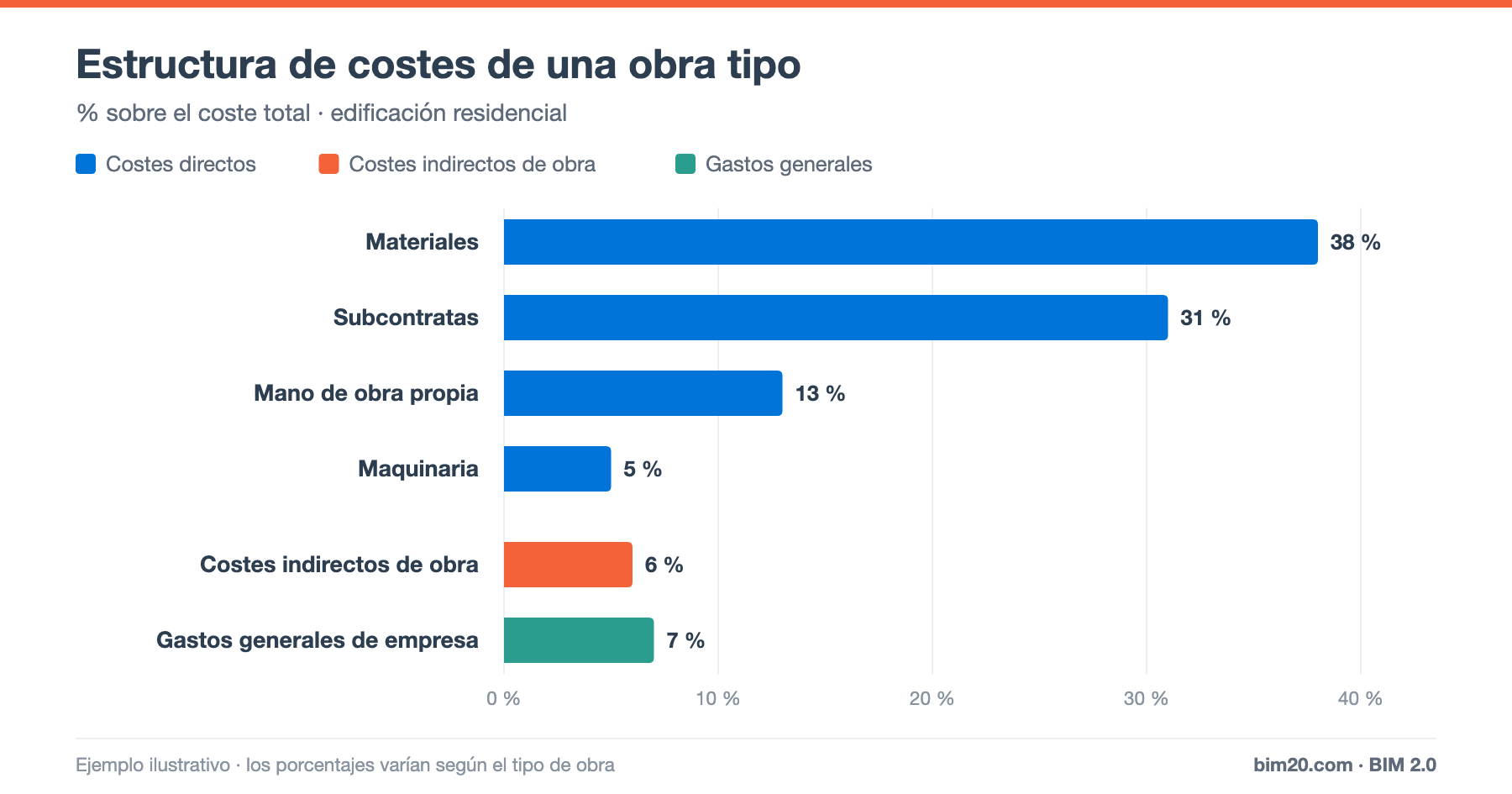
Cost structure of a typical project
As an illustrative example, in a residential building project the breakdown could be:
- Materials: 38%
- Subcontracts: 31%
- Own labor: 13%
- Equipment: 5%
- Project indirect costs: 6%
- Company overheads: 7%
These are indicative figures, not a standard: percentages vary greatly depending on the company model. A contractor that subcontracts almost everything will have little own labor and many subcontracts.
Why it matters to tell them apart
- Estimate correctly: if you forget indirect costs, the price does not cover the crane or the foreman.
- Avoid duplication: if you include the crane in every line item and also in indirect costs, the estimate becomes more expensive for no reason.
- Control the duration: indirect costs are the cost of time; every month of delay increases them.
- Calculate real margins: the project gross margin includes direct and project indirect costs; the net margin also includes company overheads.
How to control indirect costs
- Budget them by month, not just as a percentage.
- Charge actual costs each month for site staff, cabins, crane and utilities.
- Compare against what was planned for the month, not against production: if production is delayed, the percentage of indirect costs over production shoots up.
- Watch the duration with the critical path.
Frequently asked questions
Is a crane a direct or an indirect cost?
If it serves the whole project, it is indirect. If it is rented for a specific line item (for example, a mobile crane to erect a steel structure), it is a direct cost of that line item.
Are overheads and indirect costs the same thing?
No. Indirect costs belong to the project; overheads belong to the company.
Conclusion
Direct costs, project indirect costs and company overheads answer three different questions: what each line item costs, what it costs to keep the project open and what it costs to keep the company running. Separating them properly is the basis of a correct estimate and useful cost control.
👉 BIM 2.0 for Odoo manages indirect expenses and actual cost per project and line item. Request a demo.