Knowing how much has been spent is useful; knowing how much the project will cost when it is finished is what really allows you to make decisions. The EAC, ETC, VAC and TCPI indicators of earned value analysis exist precisely for this: projecting the final cost and measuring the effort required to meet the budget.
Definitions
- BAC (Budget at Completion): total approved cost budget.
- EAC (Estimate at Completion): forecast total cost at completion.
- ETC (Estimate to Complete): forecast cost of the remaining work = EAC − AC.
- VAC (Variance at Completion): forecast variance at the end = BAC − EAC.
- TCPI (To-Complete Performance Index): cost performance that would have to be achieved on the remaining work to meet a target.
The most commonly used EAC formulas
There is no single formula: each one answers a different assumption about the future.
1. EAC = AC + (BAC − EV): atypical variance
Assumes the variance to date was a one-off and that the rest of the project will be executed at the planned cost. Use it only if the cause is identified and will not recur (for example, a geotechnical surprise that has already been resolved).
2. EAC = BAC / CPI: typical variance
Assumes that the current cost performance will continue. It is the most widely used and usually the most realistic when the variance is due to prices or productivity.
3. EAC = AC + (BAC − EV) / (CPI × SPI): cost and schedule
Assumes the rest of the project will be affected by both the cost overrun and the delay. It is the most pessimistic and is suitable when the delay forces you to accelerate (more resources, overtime) or lengthens indirect costs.
4. EAC by re-estimate
All remaining work is re-budgeted (a bottom-up ETC) and added to AC. It is the most accurate but also the most costly; it makes sense in quarterly reviews or after major changes.
Comparative example
Project data at month 4:
- BAC = €500,000
- EV = €180,000
- AC = €195,000
- CPI = EV / AC = 180,000 / 195,000 = 0.923
- SPI = 0.90
- Planned duration: 10 months
Results:
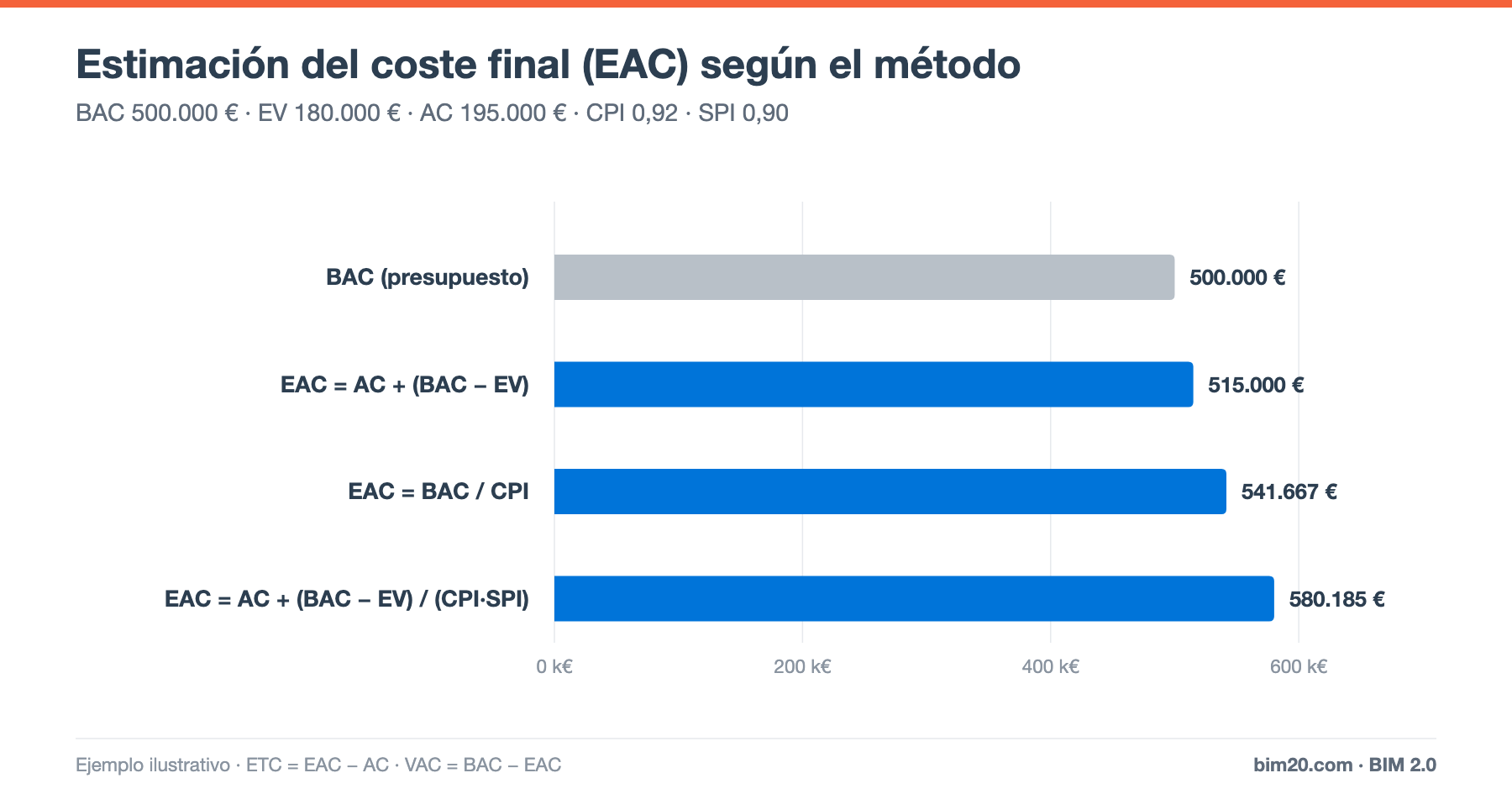
- Atypical EAC = 195,000 + (500,000 − 180,000) = €515,000
- Typical EAC = 500,000 / 0.923 = €541,667
- Cost and schedule EAC = 195,000 + 320,000 / (0.923 × 0.90) = €580,185
The range runs from €515,000 to €580,185: a difference of more than €65,000. That is why it is important to understand why the variance occurred before choosing the formula. Price and usage variance analysis helps you decide.
With the typical EAC:
- ETC = 541,667 − 195,000 = €346,667
- VAC = 500,000 − 541,667 = −€41,667
TCPI: the effort required
TCPI answers the question: how efficiently do I have to work from now on to meet the target?
TCPI (to meet the BAC) = (BAC − EV) / (BAC − AC)
In the example: (500,000 − 180,000) / (500,000 − 195,000) = 320,000 / 305,000 = 1.049.
In other words, to finish within budget the rest of the project would have to be executed with a CPI of 1.05, when so far it has run at 0.92. An improvement of that size is very hard to achieve in practice. The practical conclusion is to review the target (approve a new cost budget or claim changes from the client) rather than wait for a miracle.
TCPI (to meet the EAC) = (BAC − EV) / (EAC − AC)
With the typical EAC it comes out at 0.923, equal to the current CPI: logical, because that EAC assumes performance is maintained.
Rule of thumb
- TCPI ≤ 1.00: target achievable.
- TCPI between 1.00 and 1.10: demanding; needs a concrete plan.
- TCPI > 1.10: unrealistic; consider resetting the target.
Schedule forecast
In a similar way, a simple estimate of the final duration is:
Estimated duration = planned duration / SPI → 10 / 0.90 ≈ 11.1 months (in the example, a delay of about one month).
Keep in mind the limitations of SPI towards the end of the project (we explain them in CPI and SPI) and always cross-check with the critical path.
Common mistakes
- Always choosing the most optimistic formula.
- Calculating EAC with an incomplete AC (pending invoices).
- Not updating the BAC with approved change orders.
- Confusing cost EAC with a sales forecast: to get the margin you need both. See project margin.
Frequently asked questions
Which EAC formula should I use by default?
BAC / CPI is the most used and is usually reasonable. Complement it with the cost-and-schedule one as a pessimistic scenario.
How often is EAC updated?
Monthly, at the project's financial close.
Conclusion
EAC, ETC, VAC and TCPI turn past data into a forecast of the future. Using several formulas and understanding their assumptions lets you present management with a realistic range for the final cost and decide in time.
👉 With BIM 2.0 for Odoo you have each project's earned value in the same system as the budget and analytic accounting. Request a demo.