Payment milestones are the points in a project, tied to specific completed works, at which the contractor is entitled to collect part of the price. They are very common in private contracts (single-family homes, renovations, industrial buildings, turnkey projects) as an alternative to monthly certification based on measurements.
Well defined, they bring clarity to both parties. Poorly defined, they can leave the contractor financing the project for months.
Payment milestones vs. monthly certification
- Monthly certification: each month the client pays for what was actually executed, based on measurements and unit prices. See how to prepare a progress certification.
- Payment milestones: a fixed percentage of the price is paid when a verifiable milestone is reached (for example, "structure completed").
Advantages of milestones
- Administrative simplicity: no need to measure and value work every month.
- Clarity for the client: they know how much they will pay and when.
- Incentive to progress: the contractor gets paid when phases are completed.
Drawbacks
- A mismatch between cost and collection if the milestones are poorly staggered.
- Disputes over whether a milestone is "really" complete.
- Little flexibility if the sequence of work changes.
Example of a milestone schedule
For a 12-month project:
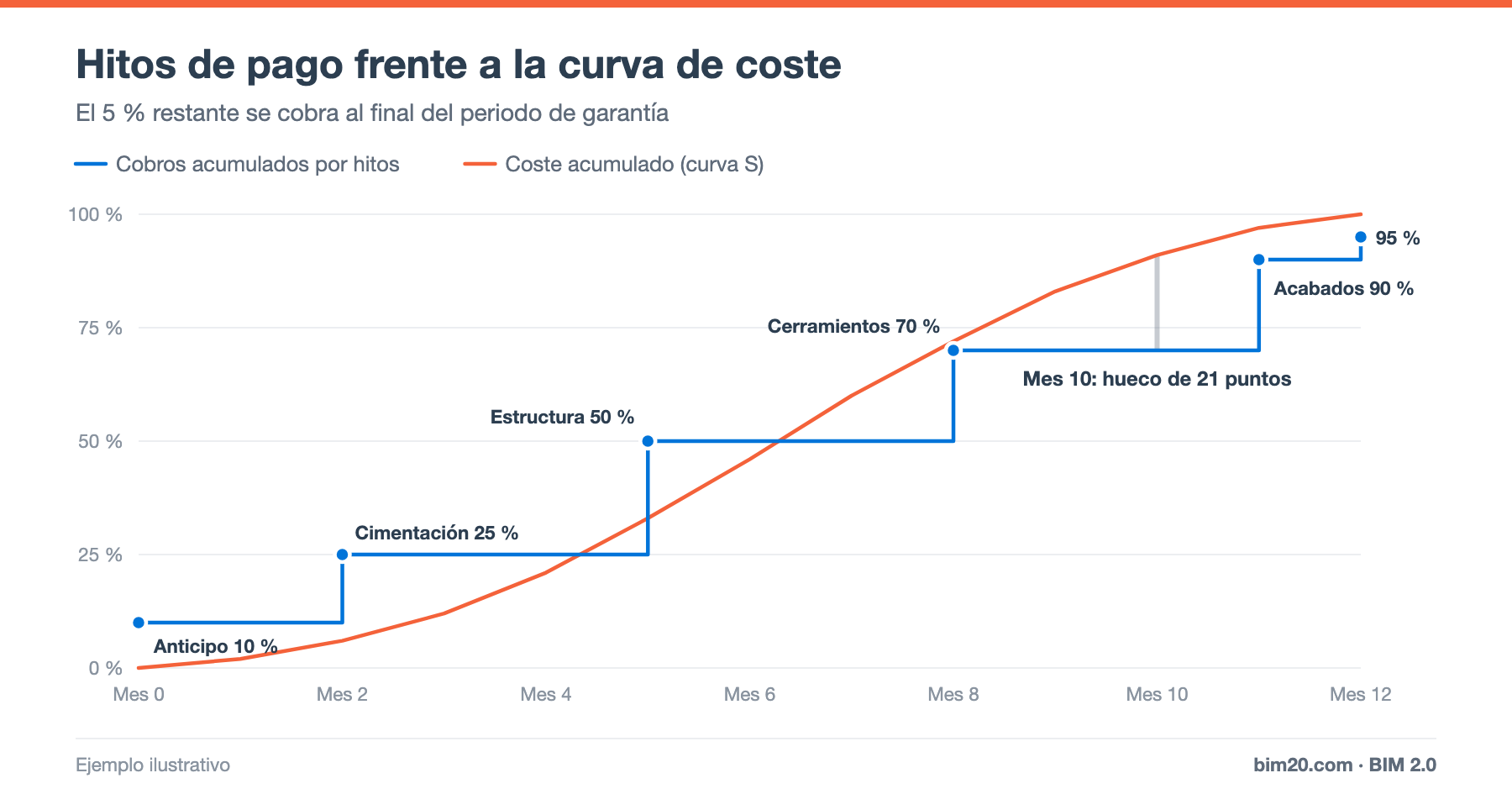
- Contract signing – advance payment: 10%
- End of foundations (month 2): 15% (cumulative 25%)
- End of structure (month 5): 25% (cumulative 50%)
- Enclosure and roof (month 8): 20% (cumulative 70%)
- Services and finishes (month 11): 20% (cumulative 90%)
- Project handover (month 12): 5% (cumulative 95%)
- End of the warranty period: 5% (cumulative 100%)
The risk: the financing gap
If we compare cumulative collections with the cumulative cost of the project (the cost S-curve), we can see the periods when the contractor is ahead of collection. With an example cost curve:
- Month 4: cost 21%, collected 25% → the advance and the first milestone cover the cost.
- Month 7: cost 60%, collected 50% → the contractor finances 10 points.
- Month 10: cost 91%, collected 70% → a gap of 21 points. On a €1.2 million project, that is more than €250,000 of cost not yet collected.
This gap has to be financed with the company's own cash or with credit lines, which carries a financial cost that must be included in the price. We analyze it in detail in project cash flow.
How to define good payment milestones
1. Align the milestones with the cost curve
Distribute the percentages so that cumulative collections closely follow cumulative cost. Avoid milestones that are far apart in the middle phase of the project, which is when most money is spent.
2. Objective, verifiable milestones
"Structure completed" must be specified: does it include the roof? The formwork removal? The laboratory certificate? The more objective, the fewer conflicts.
3. Advance payment with a guarantee
An initial advance of 5% to 15% helps finance site setup and the first material purchases. It is common for the client to require a bank guarantee for the advanced amount in return.
4. Retention and warranty
A final retention (for example, 5%) released at the end of the warranty period protects the client. It must be clearly agreed.
5. Clauses for variations
Define how additional or modified works are paid: are they added to a milestone, or invoiced separately when executed?
6. Payment terms
Set the period between milestone verification and payment (for example, 30 days). A completed milestone that is paid at 90 days widens the financing gap.
Payment milestones in public contracts
In Spanish public procurement, monthly certifications of executed work are the norm, although public-sector contract law allows payments on account for preparatory operations (such as material stockpiling), normally with a guarantee. Always check the specifications of each contract.
Payment milestones and project control
Even when you are paid by milestones, the project must be controlled with actual production and costs, not with collections:
- Margin is calculated on executed production, not on what has been invoiced.
- The difference between what has been executed and what has been invoiced is recorded as work performed not yet certified (or as advance billing if payment has been collected ahead of the work).
Frequently asked questions
What advance payment percentage is usual?
In private projects it is usually between 5% and 15%, although it varies with the size of the project, the initial material purchases and the trust between the parties.
Can milestones and monthly certification be combined?
Yes. It is common to pay the fixed-price part by milestones and to certify additional works by measurements.
Conclusion
Payment milestones simplify the relationship with the client, but they must be designed with the cost curve in front of you. A well-staggered schedule prevents the contractor from financing the project and reduces conflicts.
👉 With BIM 2.0 for Odoo you can manage construction contracts, payment statements and certifications linked to the budget. Request a demo.